Recently, Dr. Jacob Y. Cha*, together with the Porton team, including Ziqing Zuo, William B. Reid, and Dr. Thorsten Rosner, has published a research article titled "Ru-Catalyzed Reductive Dehydration of Amides to Enamines: Catalyst-Loading-Controlled Selectivity" in ACS Catalysis, the American Chemical Society journal.
This peer-reviewed journal focuses on innovative catalysis methodologies and theoretical studies related to the synthesis and properties of high-value molecules, macromolecules, and advanced materials.
Porton's publication in ACS Catalysis marks another significant breakthrough, supported by the company's strong R&D capabilities and metal catalysis technology platform. It further demonstrates Porton's core expertise in catalytic technology innovation and process development.
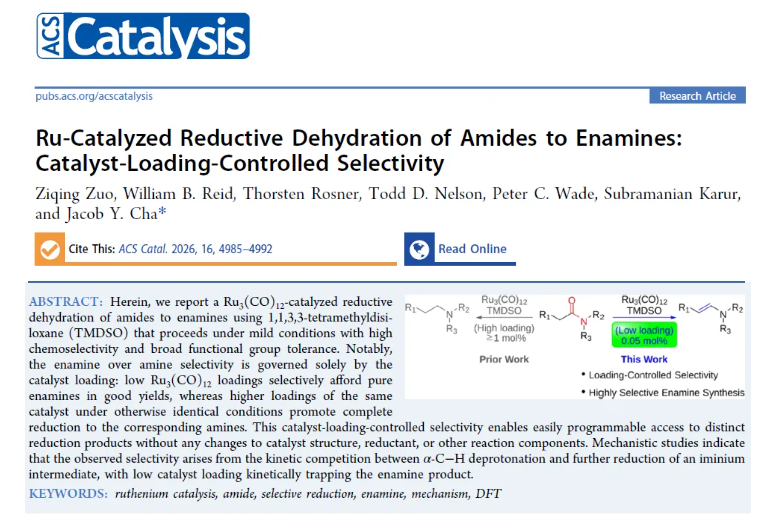
Figure 1. Paper Abstract
Enamine compounds are valuable building blocks in organic synthesis and can participate in various transformations including regioselective alkylations, acylations, annulation cascades, cycloadditions and other heterocycle forming processes. Furthermore, enamines can be readily converted to the corresponding amines through direct reduction, which constitutes an important transformation in the pharmaceutical industry. The general method for enamine synthesis is typically achieved through the condensation of a secondary amine with a carbonyl compound under Lewis or Brønsted acid catalysis conditions. Other notable methods include transition metal catalyzed cross-coupling between vinyl halides and amines, dehydrogenation of alkyl amines, and hydroamination of alkynes. Despite these advances, most of these methods require harsh reaction conditions and/or are limited to ketone-derived enamines. As such, there is a paucity of examples describing the preparation of aldehyde-derived enamines. Conditions for aldenamine preparation typically employ strong Lewis acid catalysis or high temperatures and generally require stoichiometric dehydrating reagents or extended reaction times, significantly narrowing the scope.
In this publication, Jacob Y. Cha and the Porton team highlight findings that a single catalytic system can be tuned such that it switches between partial and complete amide reduction. Traditionally, selective amide reduction typically necessitates changes in catalyst structure, additives, or overall reaction conditions. However, in this publication they report a fundamentally different approach in which the chemoselectivity for enamines is governed solely by catalyst loading. At low Ru3(CO)12 loadings, enamine formation is strongly favored, whereas higher catalyst loadings promote complete reduction to amines. Once formed, the enamine remained chemically inert, avoiding overreduction to the amine, even with increased catalyst loadings that would have allowed direct reduction of the amide to the amine. This observation proved that the enamine was not merely an intermediate en route to the fully reduced amine.
The team hypothesized that loading-dependent divergence in reactivity reveals the existence of two distinct catalytic regimes within a single catalytic system. A series of experimental and computational studies highlighted that the enamine and amine products are both formed from a common iminium ion intermediate, however the enamine does not serve as a direct intermediate for the reduction to the amine, but rather an off-cycle byproduct.